안면마비 치료, 초음파 유도 접근법이 답일까?
얼굴 반쪽이 마비된 채 6개월째, 이 환자는 왜 낫지 않을까?
"아침에 일어났는데 얼굴 오른쪽이 전혀 움직이지 않아요." 6개월 전 갑자기 시작된 안면마비로 고생하고 있는 환자분의 호소입니다. 처음엔 단순 스트레스로 생각했지만 시간이 지나도 호전되지 않아 신경과에서 스테로이드 치료와 물리치료를 받았지만 여전히 눈을 감거나 입꼬리를 올리는 것이 힘들다고 합니다.
안면마비는 안면신경(제7뇌신경)의 기능 저하로 발생하는 질환으로, 연간 인구 10만 명당 약 20~30명에서 발생하는 것으로 알려져 있습니다. 특히 벨마비(Bell's palsy)가 가장 흔한 형태로 전체 안면마비의 70~80%를 차지합니다. 최근 대만에서 발표된 연구에 따르면, 기존의 표재성 접근법으로는 안면신경 간부에 정확하게 도달하기 어려워 치료 효과가 제한적이었다고 보고되었습니다.
원제: Ultrasound-Guided Approach to the Facial Nerve Trunk: Anatomical Validation and Clinical Feasibility
안면마비는 왜 생기고, 어떤 메커니즘으로 진행될까?
안면신경은 뇌간에서 시작되어 측두골의 안면신경관(fallopian canal)을 거쳐 경상유돌공(stylomastoid foramen)을 통해 나온 후 이하선 내부로 들어가 얼굴 근육들을 지배합니다. 이 신경이 손상되면 표정근의 마비, 미각 장애, 눈물과 침 분비 감소 등의 증상이 나타납니다.
안면마비의 발생 원인은 다양하지만, 바이러스 감염으로 인한 염증이 신경관 내부에서 신경을 압박하는 것이 주요 메커니즘으로 여겨집니다. 기존 연구들에서는 헤르페스 바이러스나 대상포진 바이러스가 신경 주변의 염증 반응을 일으켜 신경 전도를 방해한다고 보고하였습니다. 문제는 이러한 염증이 만성화되면서 섬유성 유착이 형성되어 신경 기능 회복을 더욱 어렵게 만든다는 점입니다.
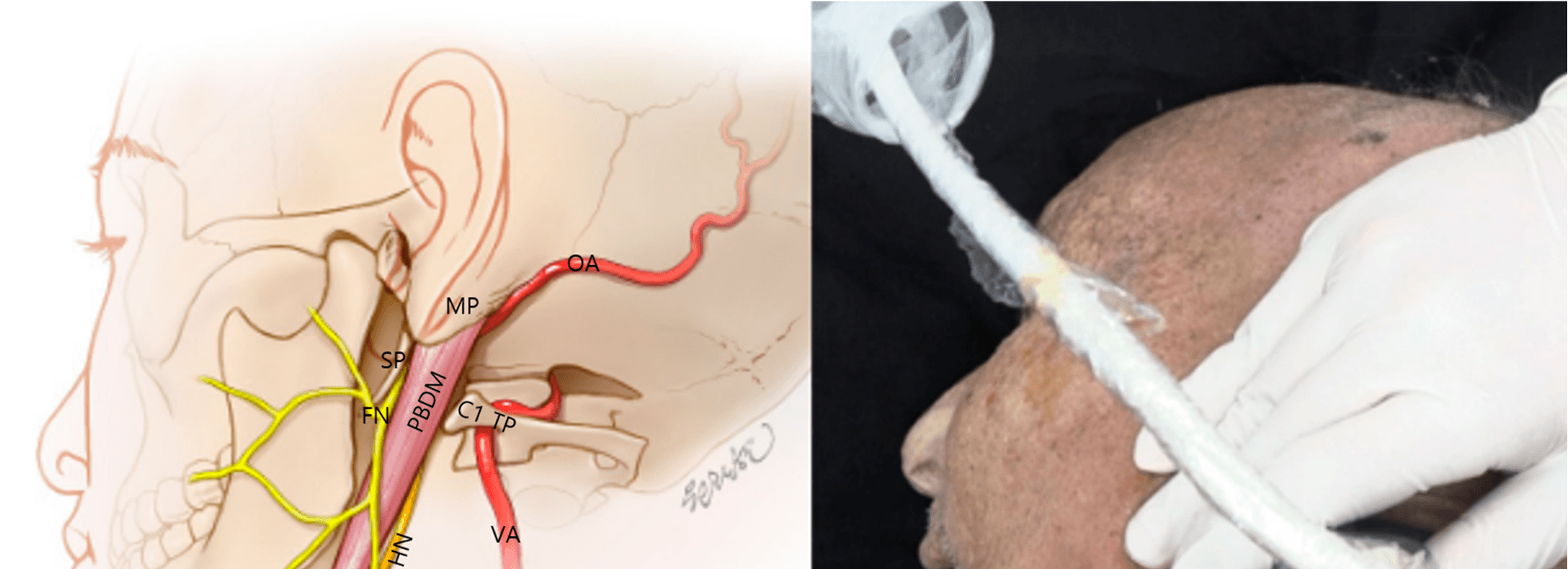 Figure 1. Anatomical schematic ( left ) and cadaveric ultrasound probe positioning ( right ) for ultrasound-guided identification of the facial nerve (FN) trunk. The illustration highlights the FN and hypoglossal nerve (HN) in orange, along with adjacent vascular structures—the vertebral artery (VA) and occipital artery (OA)—in red. The posterior belly of the digastric muscle (PBDM) is shown as a key muscular landmark. Relevant bony landmarks—the styloid process (SP), mastoid process (MP), and C1 transverse process (C1 TP) and lamina—are also depicted to guide accurate localization. The cadaveric image demonstrates real probe placement aligned over these struc- tures, with the probe oriented obliquely to visualize the stylomastoid foramen in ultrasound. SCM, sternocleidomastoid muscle.
이번 연구는 어떻게 진행되었을까?
연구진은 안면신경 간부에 정확하고 안전하게 접근하기 위한 초음파 유도 프로토콜을 개발하고자 사체 해부와 생체 초음파 검사를 병행하였습니다. 고해상도 실시간 초음파 장비를 사용하여 경상유돌공 주변의 해부학적 구조를 체계적으로 분석했습니다.
주요 연구 방법으로는 표준화된 프로브 조작 기법을 통해 유양돌기(mastoid process), 경상돌기(styloid process), 이복근 후복부(posterior belly of digastric muscle) 등의 해부학적 표지를 일관되게 시각화하는 것이었습니다. 특히 제1경추(C1)의 횡돌기와 후궁을 기준점으로 활용하여 접근 경로의 재현성을 높였습니다.
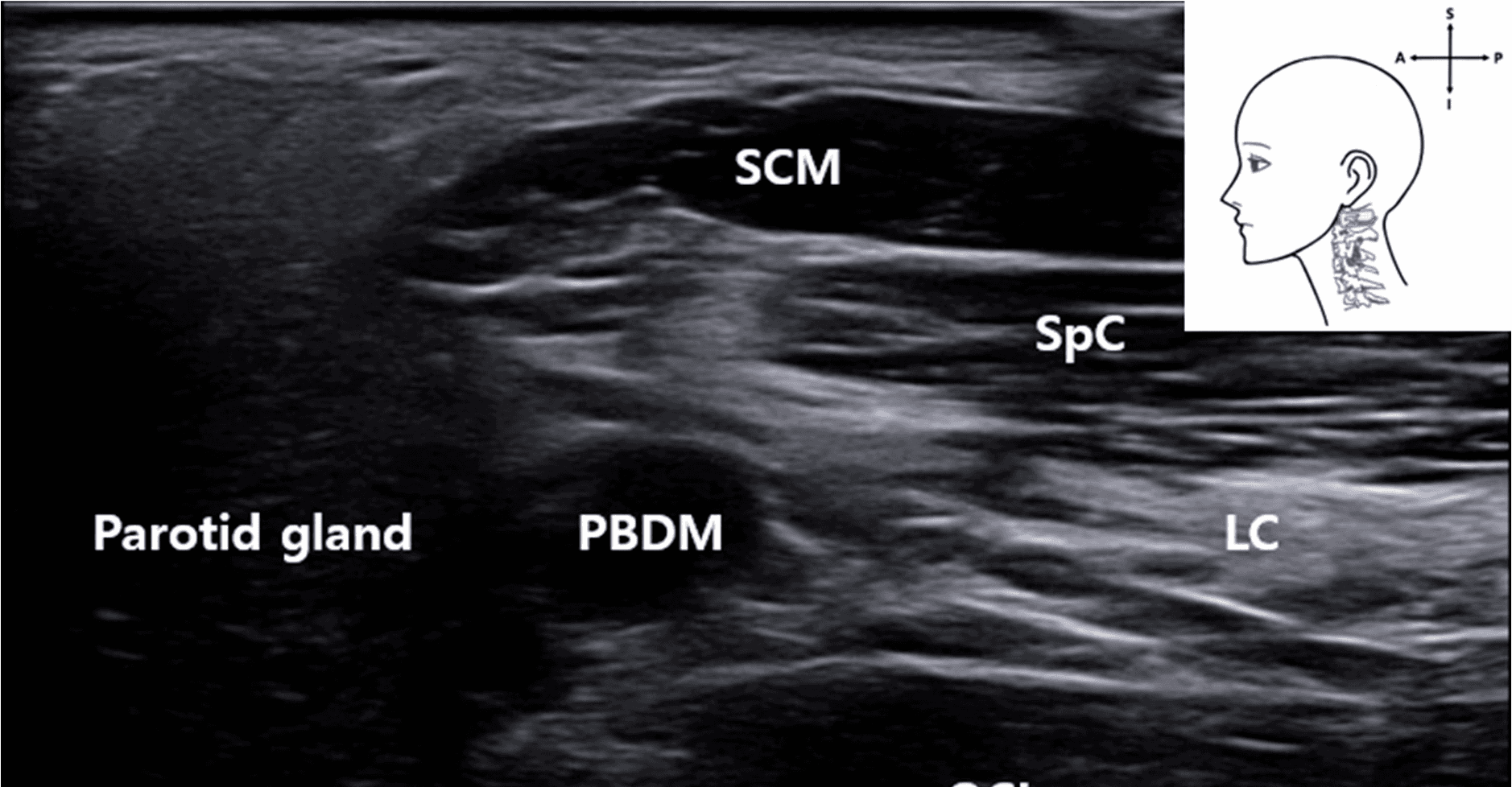
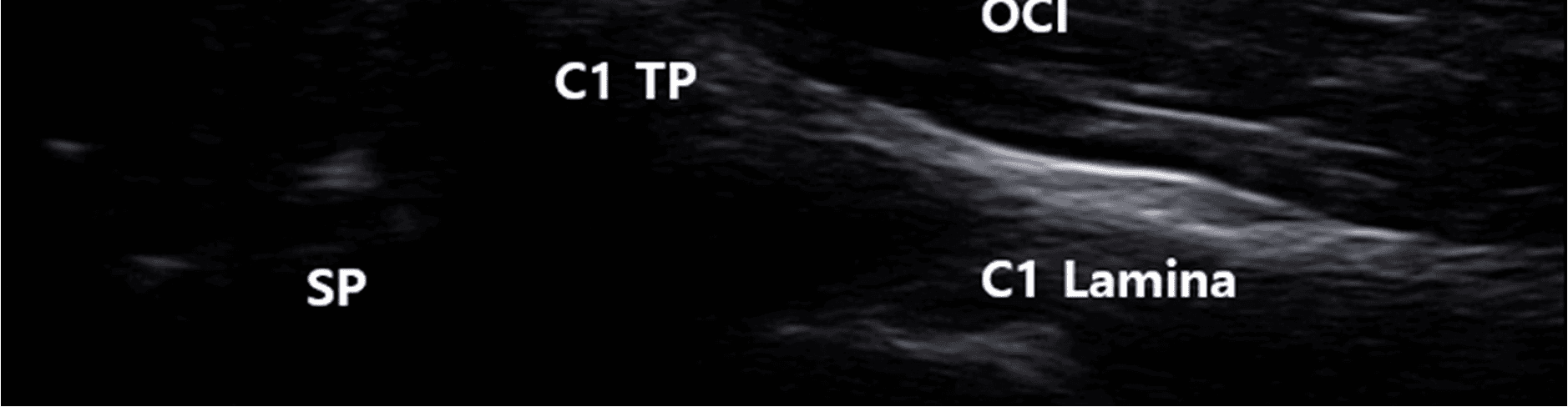 Figure 2. Ultrasound image corresponding to the anatomical dissection of the right lateral neck showing key muscular and bony landmarks related to C1 identification and FN approach. SCM , sternocleidomastoid muscle; SpC , splenius capitis muscle; LC , longissimus capitis muscle; OCI , obliquus capitis inferior muscle; PBDM , posterior belly of the digastric muscle; C1 TP , transverse process of the atlas (C1); C1 Lamina , lamina of the atlas (C1); blue rectangle, probe position.
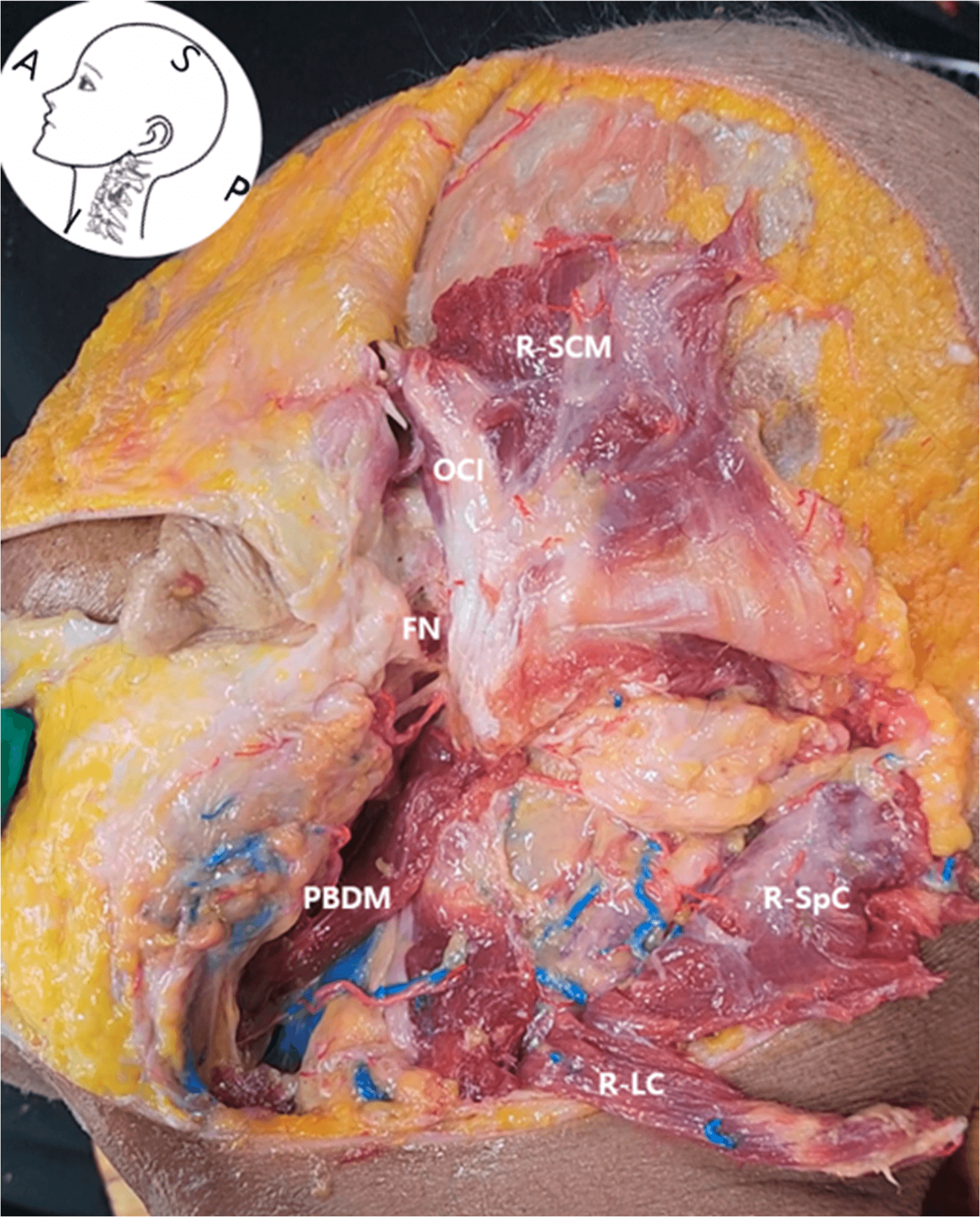 Figure 3. Layer-by-layer dissection of the right lateral neck showing key anatomical structures for ultrasound-guided FN access. FN , facial nerve; PBDM , posterior belly of the digastric muscle; R- SCM , reflected sternocleidomastoid muscle; R-SpC , reflected splenius capitis muscle; R-LC , reflected longissimus capitis muscle; OCI , obliquus capitis inferior muscle.
도플러초음파를 활용하여 척추동맥(vertebral artery)과 후두동맥(occipital artery) 등 주요 혈관 구조의 실시간 혈류 확인도 프로토콜에 포함시켰습니다. 이는 시술 중 혈관 손상 위험을 최소화하기 위한 안전장치 역할을 합니다.
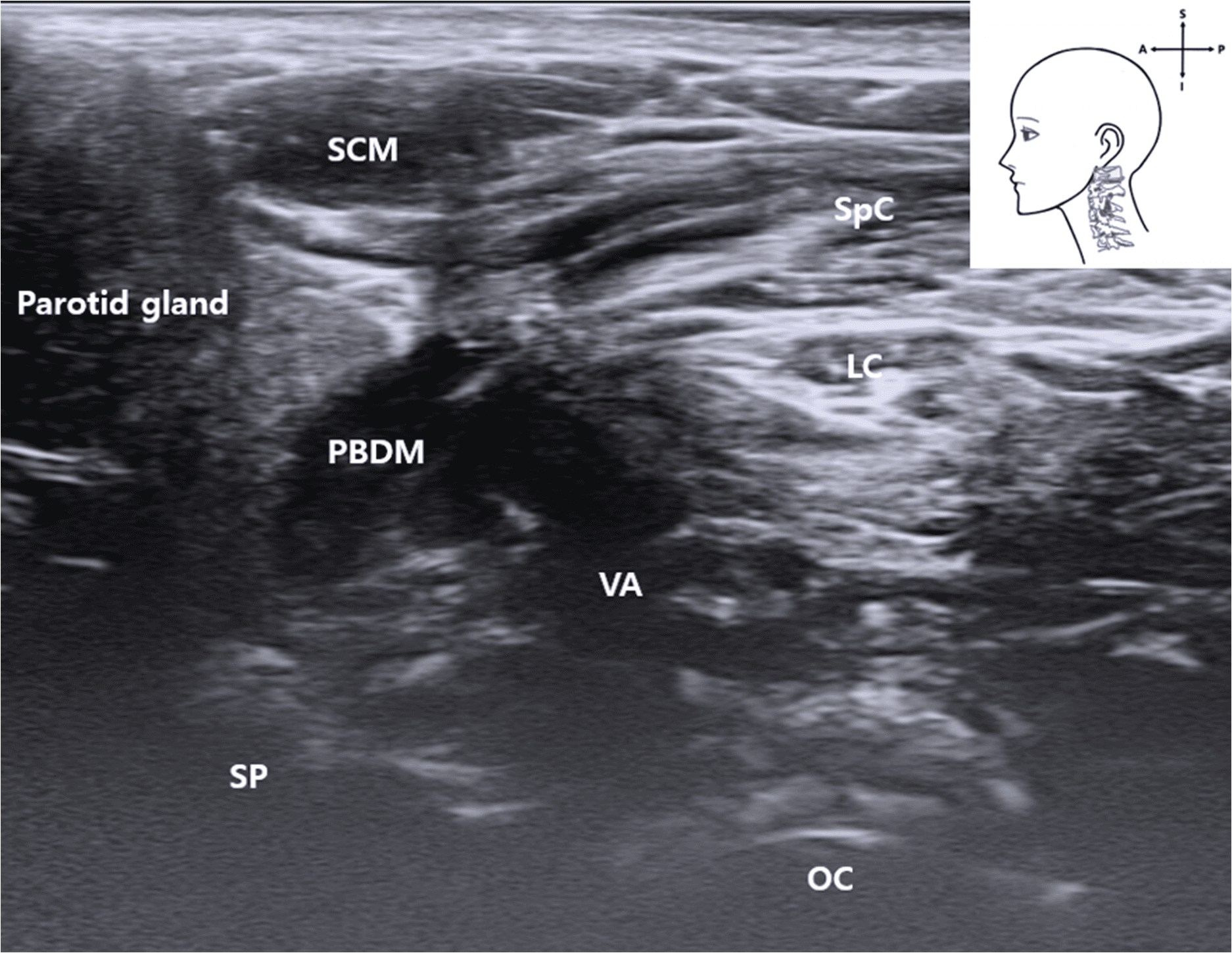 Figure 4. Ultrasound image showing the VA located deep between the posterior belly of the digastric muscle and occipital condyle. The SCM muscle lies superficially. This image was obtained with the probe tilted superiorly using a heel-toe maneuver to visualize the upper cervical region. SCM , sternocleidomastoid muscle; PBDM , posterior belly of digastric muscle; SpC , splenius capitis muscle; VA , vertebral artery; OC , occipital condyle; SP , styloid process; LC , Longissimus capitis muscle); blue rectangle, probe position.
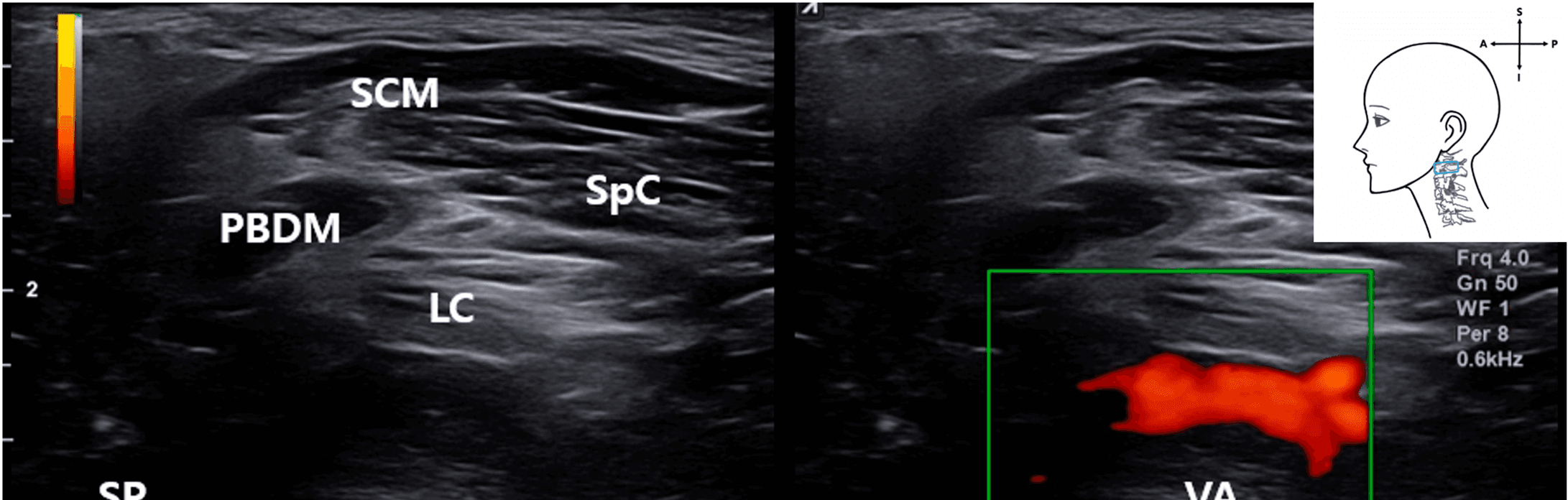 Figure 5. Live dual doppler ultrasound in a living patient confirming visualization of the VA. Real- time vascular flow was detected in the deep cervical plane, suggesting that this structure can be monitored during ultrasound-guided FN interventions. Color flow mapping (green box) confirms arterial characteristics. Blue rectangle, probe position.
이번 연구가 밝힌 핵심 결과는 무엇일까?
연구 결과 초음파를 통해 안면신경 간부에 안전하고 효과적으로 접근할 수 있는 재현 가능한 구조화된 접근법이 성공적으로 확립되었습니다. 표준화된 프로브 조작 기법을 사용하여 경상유돌공, 유양돌기, 이복근 후복부 등 중요한 해부학적 표지를 일관되게 시각화할 수 있었습니다.
특히 고해상도 초음파로 제1경추 횡돌기와 후궁을 안정적으로 시각화할 수 있었고, 프로브를 상방으로 기울이는 heel-toe 기법을 통해 척추동맥을 상부 경추 부위에서 일관되게 확인할 수 있었습니다.
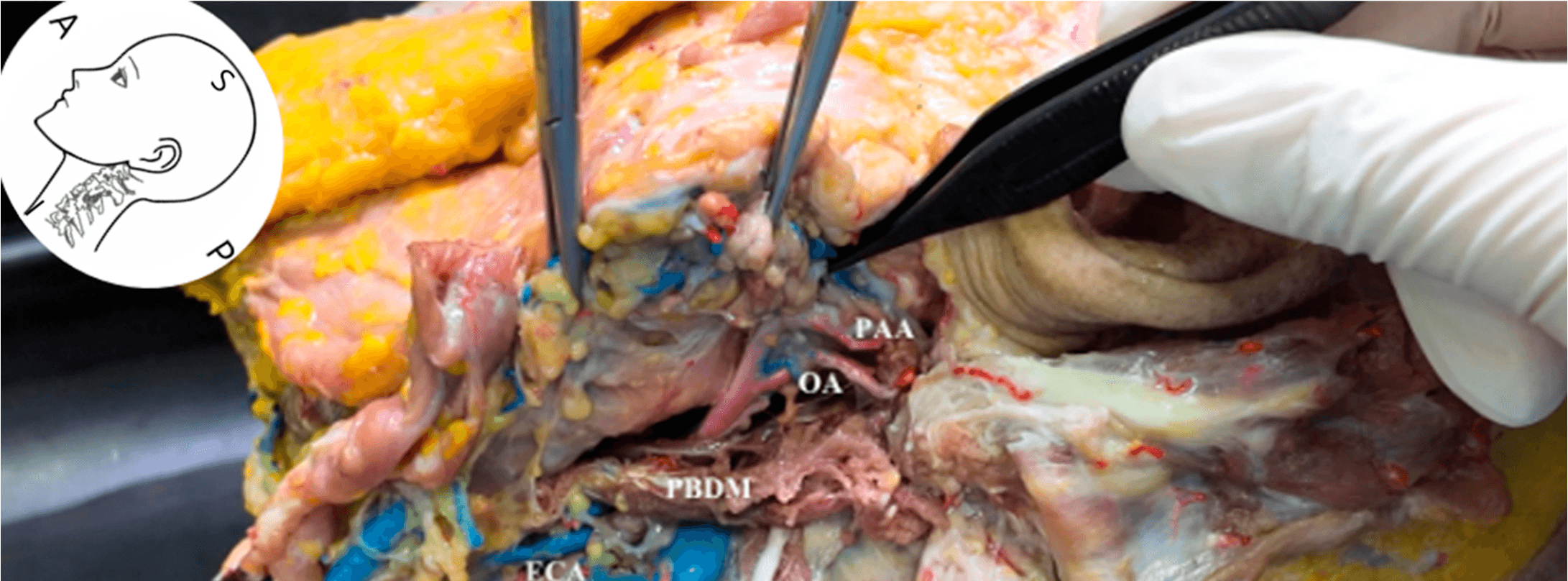 Figure 6. Cadaveric dissection showing the anatomical relationship of the OA. The OA arises from the external carotid artery and courses posterolaterally beneath the posterior belly of the digastric muscle toward the skull base. The PAA is also visible. ECA , external carotid artery; OA , occipital artery; PAA , posterior auricular artery; PBDM , posterior belly of digastric muscle.
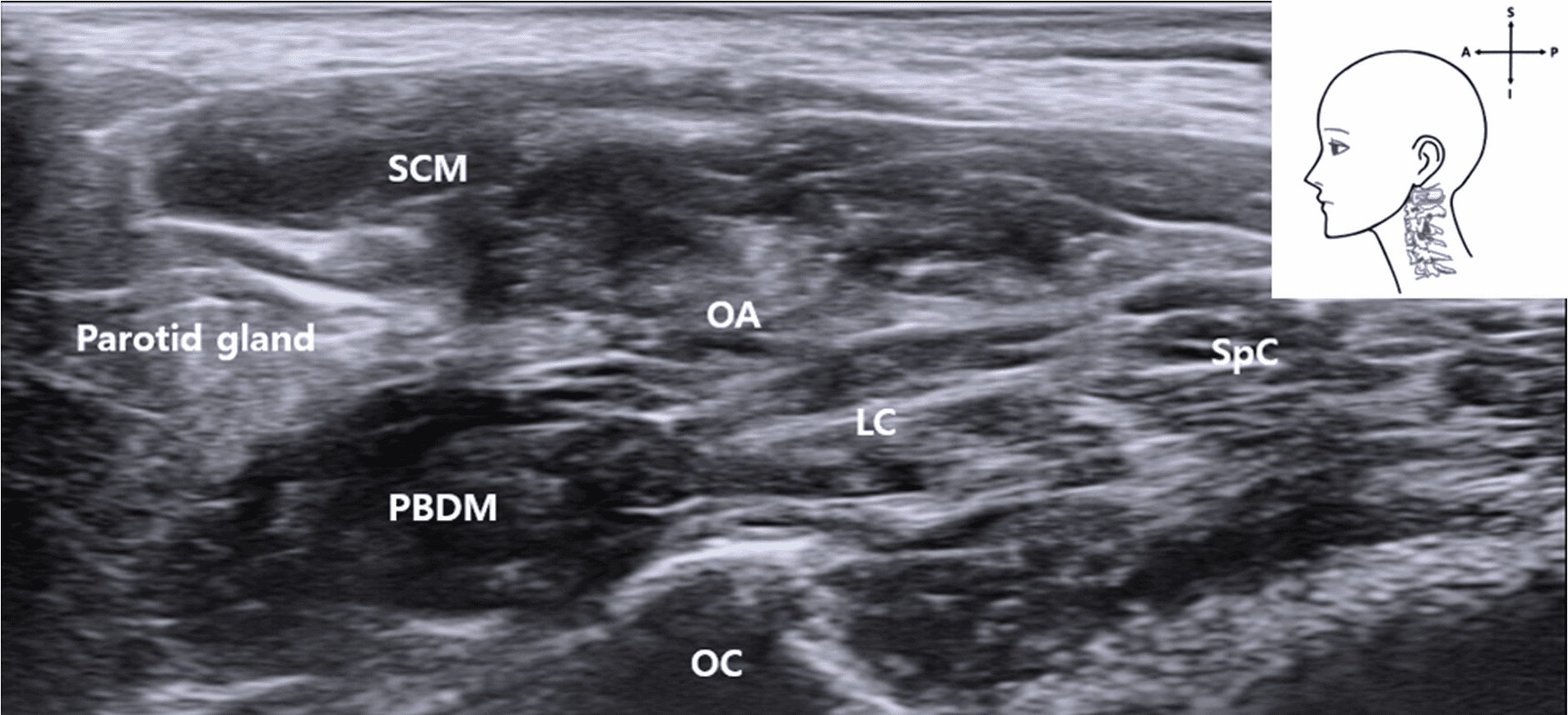 Figure 7. Ultrasound image showing the OA coursing parallel and just deep to the posterior belly of the digastric muscle in a longitudinal (long axis) orientation. The occipital bone (occiput) is seen at the bottom of the image, serving as a deep osseous landmark. SCM , sternocleidomastoid muscle; SpC , splenius capitis muscle; LC , Longissimus capitis muscle; PBDM , posterior belly of digastric muscle; OA , occipital artery; OC , occipital condyle; SP , styloid process); blue rectangle, probe position.
실시간 도플러초음파를 통해 생체에서 척추동맥과 후두동맥의 혈관 흐름을 확인하여 초음파 유도 시술 중 혈관 구조 식별이 가능함을 입증하였습니다. 컬러 플로우 매핑을 통해 동맥의 역동성을 확인하고 인접한 비혈관 구조와 명확히 구별할 수 있었습니다.
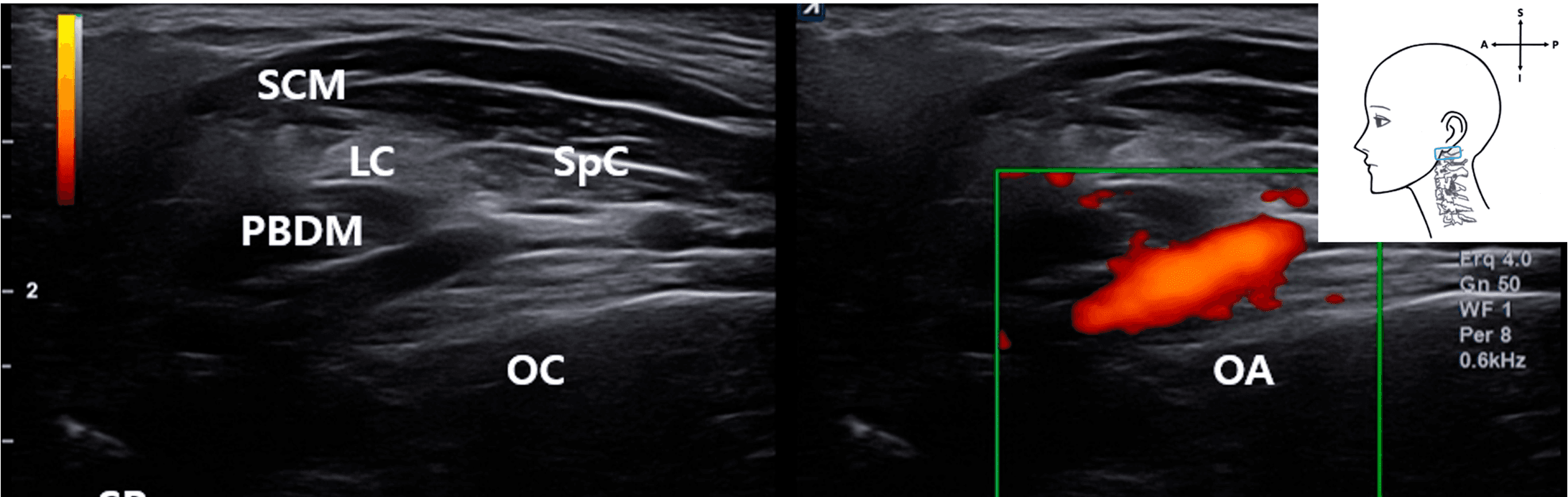 Figure 8. Color Doppler ultrasound image from a live patient showing the OA coursing obliquely through the scanning field. The probe position and Doppler application reveal real-time vascular
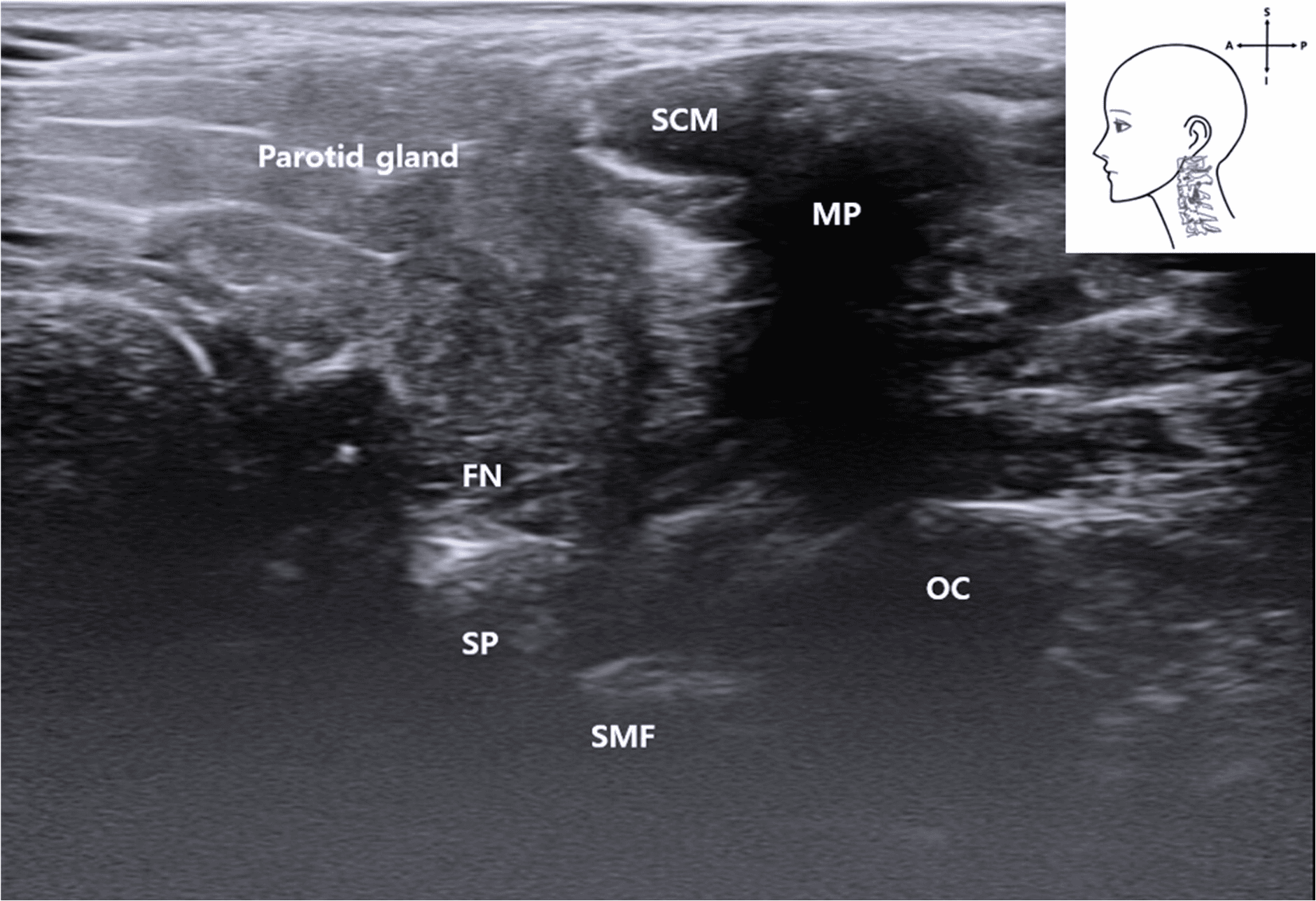 Figure 9. Ultrasound image showing the FN emerging between the mastoid and SP. The stylomastoid foramen is not directly visualized as a discrete opening but inferred from the acoustic shadowing pattern between the bony landmarks. MP , mastoid process; PBDM , posterior belly of digastric muscle; FN , facial nerve; SP , styloid process; OC , occipital condyle; SCM , sternocleidomastoid muscle; SMF , stylomatoid foramen); blue rectangle, probe position.
사체를 이용한 염료 주입 실험에서는 이복근 후복부 전방을 목표로 한 초음파 유도 주사가 안면신경 간부 근처로 정확히 확산되는 것을 확인했습니다. 이는 실제 임상에서 약물이나 치료 물질을 목표 부위에 정확히 전달할 수 있음을 의미합니다.
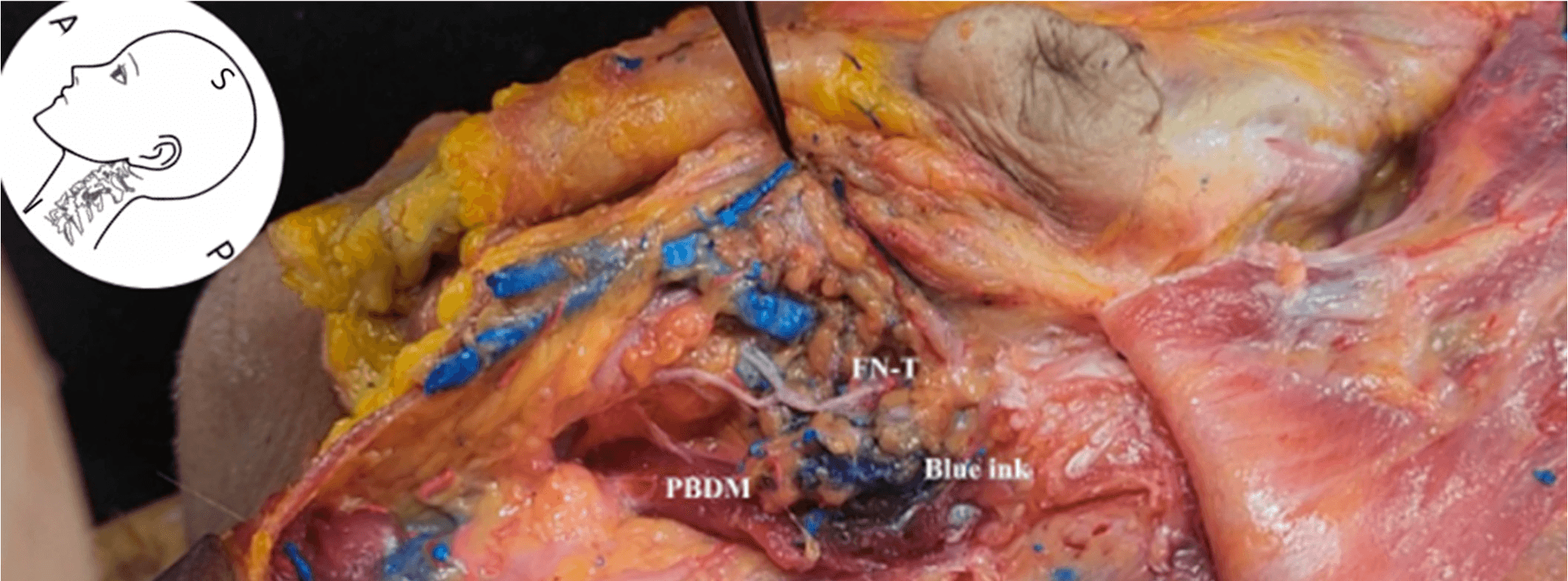 Figure 10. Cadaveric dissection showing the diffusion of blue dye following ultrasound-guided injec- tion targeting the anterior aspect of the posterior belly of the digastric muscle. The dye successfully spread toward the FN trunk near the styloid process, confirming the accuracy and feasibility of the ultrasound-based approach. PBDM , posterior belly of digastric muscle; FN-T , facial nerve trunk; Blue ink , diffusion marker.
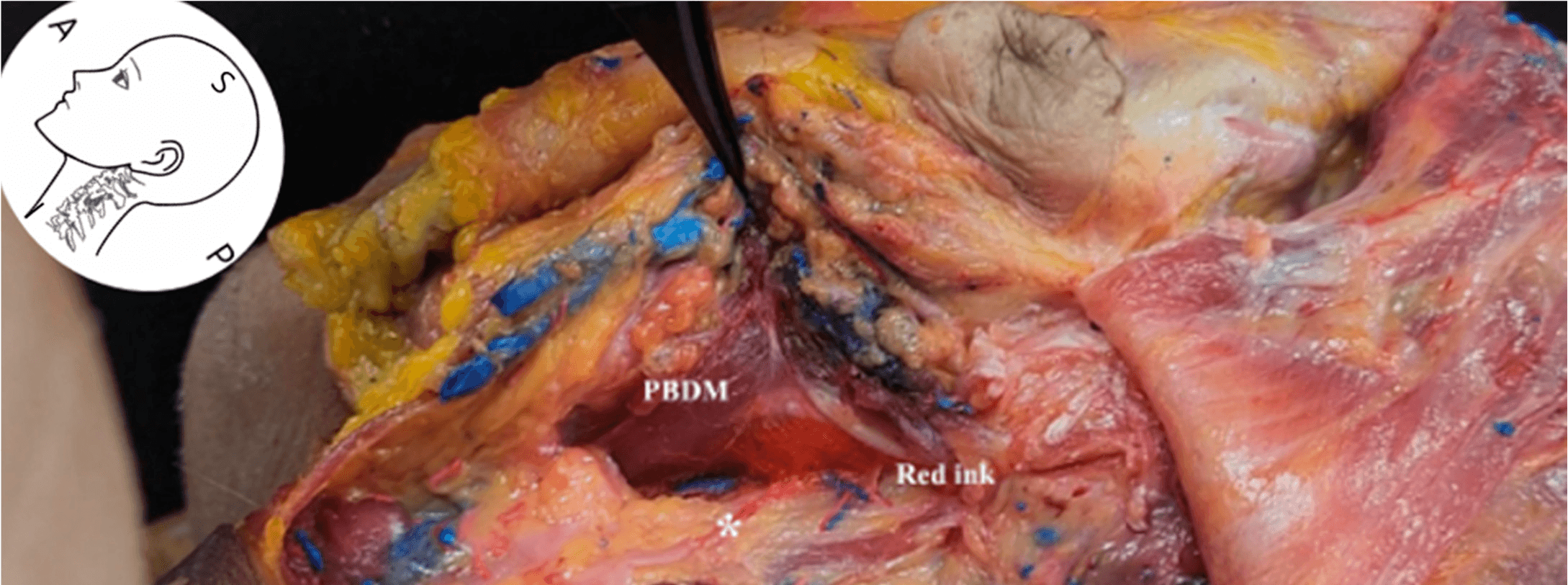 Figure 11. Cadaveric dissection showing red dye distribution following ultrasound-guided injection targeting the posterior aspect of the posterior belly of the digastric muscle. The dye spreads posterior and deep to the styloid process, following the anatomical course of the hypoglossal nerve. This validates the feasibility of ultrasound-guided deep-plane targeting hypoglossal nerve access. PBDM , posterior belly of digastric muscle; Red ink , diffusion marker; asterisk , hypoglossal nerve.
기존 치료법과 어떻게 다르고, 임상적으로 무엇을 의미할까?
이 연구가 제시한 초음파 유도 접근법은 기존 치료의 한계를 극복할 수 있는 새로운 가능성을 보여줍니다. 기존 연구들이 주로 표재성 근육층이나 안면마비의 비대칭 감지에만 집중되어 안면신경 간부에 정확한 접근이 어려웠던 반면, 이번 연구는 심부 구조까지 체계적으로 접근할 수 있는 방법을 제시했습니다.
특히 스테로이드 주사나 경구 약물 치료가 효과적이지 않은 만성 안면마비 환자들에게 새로운 치료 옵션이 될 수 있습니다. 초음파 유도 하 수핵분해술(hydrodissection)은 신경을 압박하는 섬유성 조직으로부터 분리하여 기계적 감압과 생화학적 신경보호 효과를 동시에 제공합니다.
표준화된 프로브 조작 기법과 일관된 해부학적 표지를 통해 시술의 재현성과 안전성을 크게 향상시킬 수 있다는 점도 중요한 의미입니다. 도플러초음파를 통한 실시간 혈관 모니터링은 혈관 손상 등의 합병증 위험을 최소화하면서도 치료 효과를 극대화할 수 있는 방법론을 제공합니다.
하지만 이 연구가 해부학적 타당성 확인에 중점을 둔 기초 연구라는 점에서, 실제 임상 적용을 위해서는 더 많은 환자군을 대상으로 한 치료 효과 검증이 필요할 것으로 보입니다.
한의학에서는 안면마비를 어떻게 접근할까?
한의학에서 안면마비는 '구안와사(口眼喎斜)' 또는 '면신경마비'로 불리며, 주로 풍사(風邪)의 침입이나 기혈순환 장애로 인한 경락의 기능 실조로 봅니다. 특히 족양명위경과 족소양담경 등이 얼굴 부위를 순행하면서 표정근을 영양하는데, 이러한 경락의 기혈 흐름이 막히면 안면마비가 발생한다고 이해합니다.
이번 연구에서 제시한 초음파 유도 접근법은 한의학의 경락 이론과도 잘 부합합니다. 안면신경이 주행하는 경로가 족소양담경의 완골(完骨)과 풍지(風池) 혈자리 주변과 해부학적으로 일치하기 때문입니다. 특히 이복근 후복부 주변은 예풍(翳風) 혈자리와 인접하여 전통적으로 안면마비 치료에 중요하게 활용되어 온 부위입니다.
고양시 지역에서 내원하는 안면마비 환자들의 경우, 침치료와 함께 약침이나 봉침 등을 예풍, 협거(頰車), 지창(地倉) 등의 혈자리에 적용하여 국소 기혈순환을 개선하는 치료를 시행합니다. 이러한 접근법이 연구에서 제시한 초음파 유도 기법과 결합된다면 더욱 정확하고 안전한 치료가 가능할 것으로 기대됩니다.
일상에서 안면마비 회복을 위해 무엇을 실천할 수 있을까?
안면마비 회복을 위해서는 꾸준한 안면근육 운동이 필수적입니다. 거울을 보면서 눈을 천천히 깜빡이고, 입꼬리를 올리는 동작을 하루에 여러 번 반복해보세요. 처음에는 손으로 도움을 주어도 괜찮습니다.
따뜻한 찜질을 통해 안면 부위의 혈액순환을 개선하는 것도 도움이 됩니다. 40도 정도의 온도로 하루 2-3회, 10-15분씩 안면마비 부위에 찜질하면 근육 긴장 완화와 신경 회복에 도움이 될 수 있습니다.
스트레스 관리도 중요합니다. 과도한 스트레스는 면역력을 저하시켜 신경 회복을 지연시킬 수 있으므로, 충분한 수면과 규칙적인 생활 패턴을 유지하는 것이 좋습니다.
음식을 섭취할 때는 마비된 쪽으로 음식물이 고이지 않도록 주의하고, 뜨겁거나 매운 음식은 감각 저하로 인한 상처 위험이 있으므로 피하는 것이 좋습니다.
그 환자분은 어떻게 되셨을까요?
앞서 소개한 환자분의 경우 초음파 검사를 통해 안면신경 주행 경로를 확인한 후 예풍과 완골 혈자리 부근에 정밀한 침치료와 약침 치료를 시행했습니다. 특히 이복근 후복부와 경상돌기 주변의 긴장된 근육과 유착된 조직을 풀어주는 데 중점을 두었습니다.
치료 시작 후 2주 정도부터 눈 깜빡임이 조금씩 개선되기 시작했고, 4주차부터는 입꼬리를 살짝 올릴 수 있게 되었습니다. 8주차 평가에서는 일상생활에서 크게 불편하지 않을 정도로 안면 기능이 회복되었습니다.
한약 처방도 병행하여 혈액순환 개선과 신경 재생을 도왔습니다. 특히 보양환오탕 가미방을 통해 어혈을 제거하고 기혈순환을 원활하게 하여 전반적인 회복 속도를 높일 수 있었습니다.
현재는 월 1-2회 정도 유지 치료를 받으면서 안면 기능을 꾸준히 관리하고 있으며, 일상생활에서 큰 제약 없이 지내고 계십니다.
기존 치료가 듣지 않는 안면마비, 어떤 선택이 있을까?
스테로이드나 항바이러스제 등 기존 약물치료가 효과적이지 않은 경우, 한의학적 접근을 고려해볼 수 있습니다. 특히 발병 후 3-6개월이 지난 만성 안면마비의 경우 침치료, 약침, 추나치료 등을 통해 신경 기능 회복을 도모할 수 있습니다.
도플러초음파를 활용한 정밀 진단을 통해 안면신경의 정확한 상태를 파악하고, 개별 환자의 증상과 체질에 맞는 맞춤형 치료 계획을 수립하는 것이 중요합니다.
안면마비로 고생하고 계신다면 늦기 전에 전문의와 상담을 받아보시기 바랍니다. 적절한 시기에 시작된 치료가 더 좋은 예후를 가져올 수 있습니다.